Categories
Podcast

Episode 122: UFOria

On this week’s episode, we talk about a rarity amongst 80s movies, one that is an oldie, a goodie, an obscurity, and one of the best reviewed movies of all the years it was released.

John Binder’s 1980 debut, UFOria. Or is it 1984? Or 1985? 1986?

It’s a crazy story. You should check it out.

UFOria
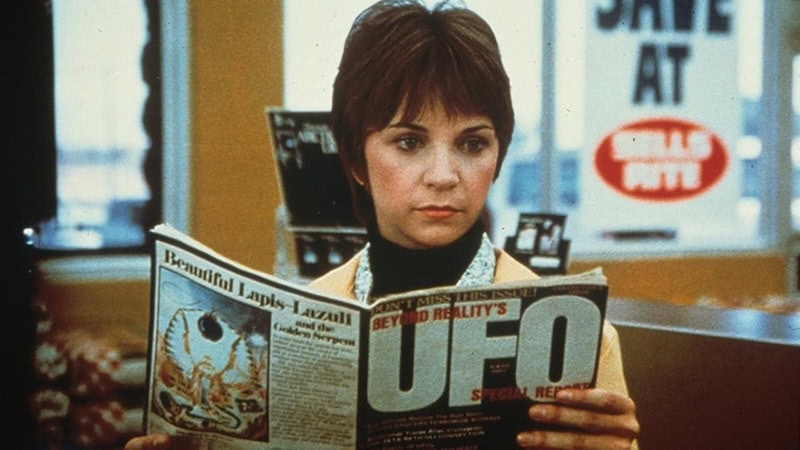
Cindy Williams as Arlene, a small town supermarket clerk who believes Jesus was brought to Earth in a UFO, in a scene from Mike Binder’s UFOria.

I really want to hear what you think, both positive and negative. Please leave your notes below. If you really like the show, please consider rating and reviewing the show on iTunes, Google Play, Spotify, Amazon Music, or the podcatcher of your choice.

Thank you again.

Edward

Goodpods Top 10 Film History Podcastsgoodpods top 10 film history podcastsListen now to The 80s Movie Podcast

You can also listen to The 80s Movie Podcast on most other major podcatchers.

UFOria Poster
The original theatrical one-sheet for the 1984 Universal Studios release of UFOria.

From Los Angeles, California, the Entertainment Capital of the World, it’s The 80s Movies Podcast. I am your host, Edward Havens. Thank you for listening today.

Before we get started, I wanted to give you, loyal listener, a heads up about the future of this podcast. As you may or may not be aware, my wife is 24 weeks pregnant with our first child. She’s due to be born in late February, and when she is born, I will be taking an eight week hiatus from the show, as I will be the one making sure both mother and child have the time they need to recover. So if you have not done so already, please make sure you are following the show on the podcatcher of your choice, so you don’t miss a new episode once I return.

Now that we’re done with that bit of housekeeping, let’s get back into the show.

On this episode, we visit an oldie, a goodie, and an obscurity from the decade that gave us many of each but rarely all at the same time. We’re talking about John Binder’s only feature directing credit, UFOria.

As always, before we get to the movie, we need to get into the back story.

This story begins in Indianapolis in the late 1950s.

Melvin Simon was a real estate developer based in Indianapolis who, after getting his start as a leasing agent for a rather new concept at the time called a shopping mall, formed his own leasing company with his younger brother Herb. By 1967, Melvin Simon and Associates owned and operated more than three million square feet of space at a number of malls in Middle America, by following a simple and successful strategy. Whenever they were planning on opening a new mall, they would entice a major anchor tenant, usually a department store, to sign on to the planned mall by offering a lower per square foot rent than the average going rate, then take that commitment to a bank, who would agree to loan them the money to make the mall based on that anchor tenant agreement. The Simon brothers, which now included older brother Fred, would have little to no personal money involved in the construction, and would cover their losses on the anchor tenant by charging higher rents to smaller tenants looking to get foot traffic from shoppers going to that anchor tenant once the mall opened.

By 1976, Melvin Simon and Associates was operating several dozen malls all across the country, and he would notice that one of the more successful tenants in his malls were the two to four screen movie theatres typical of the time. He was, at the time, the largest landlord for General Cinemas and United Artists Theatres. While in Los Angeles checking up on some of his malls, Simon would get into a friendly game of golf with Harry Saltzman, a film producer who, with Cubby Broccoli, co-produced all the Bond movies from Dr. No to The Man With the Golden Gun. On the greens, the two men started talking about the film industry, when Saltzman mentioned he was trying to finance a movie based on the popular toy line The Micronauts, but was short some of the funding. Simon agreed to cover the gap, and Saltzman put his British home up as collateral. The movie didn’t get made, and Saltzman had to sell his house to cover Simon’s investment, but the real estate magnate had been bitten by the movie making bug.

Within two years, he had created Melvin Simon Productions, and had more than $20m invested in 16 movies, including Joan Rivers’ first, and eventually, only, directing effort, a comedy called Rabbit Test that was the first lead movie role for Billy Crystal, and Somebody Killed Her Husband, the first major movie role for Farrah Fawcett-Majors since leaving Charlie’s Angels. He also had a hand in making the Brooke Shields comedy Tilt, the George Hamilton comedy Love at First Bite, and When a Stranger Calls, the Carol Kane thriller that grossed nearly fourteen times its $1.5m budget just in America alone.

Impressed with his early track record, 20th Century-Fox would sign Melvin Simon Productions to a two year deal worth $10m in September 1979. Some of the movies made under the deal would find different levels of success, including Richard Rush’s The Stunt Man, which will be getting an episode of its own in the future, the Tony Bill comedy My Bodyguard, and all three Porky’s movies. But there were a lot of failures within that deal too. The Runner Stumbles, the final film from iconoclastic filmmaker Stanley Kramer, stumbled despite starring Dick Van Dyke in a rare dramatic role, as did Scavenger Hunt, a late 70s sorta remake of one of Kramer’s biggest hits, It’s a Mad Mad Mad Man World. No one cared about The Man With Bogart’s Face, or nor George Hamilton’s followup to Love at First Bite, the unfortunate Zorro, The Gay Blade.

The smallest of the films made under the Melvin Simon/20th Century-Fox deal at that time was a sci-fi comedy called Escape. Escape had been written by John Binder, a forty year old screenwriter who had just seen his first produced screenplay, Honeysuckle Rose, become a hit for Warner Brothers and Willie Nelson. Binder had another script, Endangered Species, written with director Alan Rudolph, that was about to go into production at MGM, and was looking to make his directing debut. At $2m, Escape was a sci-fi comedy about a a drifter and small-time con man, Sheldon Bart, who catches up with an old friend, Brother Bud, a big-time con man who travels the country  with a revival tent, selling himself as a faith healer. Except, Bud actually can heal people, although he doesn’t know how this ability came to be. While working the circuit with Brother Bud, Sheldon falls in love with Arlene, a supermarket clerk in one of the towns they stop in, who is more than a bit loony and very much believes in unidentified flying objects. Arlene, who thinks flying saucers brought Jesus to Earth and that Adam and Eve were interstellar astronauts, has a vision of an impending UFO landing, and Brother Bud starts to twist Arlene’s vision into a new religious cult, for his own benefit.

Binder had been inspired to write the screenplay back in 1975, after reading a newspaper article about true-life couple who had arrived in a small town in Oregon and proclaimed spaceships were en route to take “enlightened believers” back to their home world. The article says twenty of the townsfolk had become followers of the couple.

But then, a funny thing happened on the way to production.

Cindy Williams, one of the leads of the very popular ABC TV sitcom Laverne and Shirley, got ahold of the script, and contacted the filmmaker about playing Arlene. Williams had also starred in one of the most popular movies of the 1970s, American Graffiti, and would represent her first starring role in a movie since the Best Picture nominee eight years earlier.

And in getting Cindy Williams to sign on to the lead would attract a better range of talent for the two male leads. Fred Ward, who was starting to build up a strong resume thanks to his co-starring role in the 1979 Clint Eastwood drama Escape from Alcatraz, would sign on to play Sheldon, while Harry Dean Stanton, whose resume included such diverse films as Cool Hand Luke, The Godfather Part II and Alien, came aboard to play  Brother Bud.

UFOria
Fred Ward and Cindy Williams in a scene from Mike Binder’s UFOria.

Because of the cast, Melvin Simon would up the budget for the film from $2m to $5m, and the film would be scheduled to begin eight weeks of filming in Los Angeles, as well as in Lancaster and Palmdale CA, starting June 2nd, 1980, under a new title, UFOria.

And like many a smaller film production in the 1980s, even one with a star like Cindy Williams was at the time, the production was not very well documented. In fact, the most exciting thing that seemed to happen during the production was the SAG actor’s strike that began six weeks into production, on July 21st. 67,000 actors went on strike, shutting down all but fourteen motion pictures whose producers had signed an interim agreement with the guild to continue filming in the case of a strike. UFOria was one of those fourteen films that could continue production.

Binder would work on editing the film with his cutter, Dennis M. Hill, for the remainder of 1980 and into 1981. The director would screen his final cut for the production company and the studio in the summer of 1981… and the film would be shelved. Cindy Williams, Fred Ward and Harry Dean Stanton were released from the promotional duties for the film, and it would sit on that proverbial shelf for two years. Some rumors at the time had it the film was unwatchable, others that Fox had no idea how to sell it.

But in July 1983, it was announced that Universal Studios had picked the film up for distribution from Fox for an undisclosed sum.

After some test screenings in the fall of 1983, Universal would change the title of the movie to Hold On to Your Dreams, and give it a test release at a drive-in theatre in Salem OR on March 9th, 1984. After a week of low grosses, the film would be replaced.

The next screening for the film would be on July 10th, when it played at the Los Angeles International Film Exposition, better known as FILMEX. Sheila Benson, the #2 film critic for the Los Angeles Times, would highlight the film, which had returned to being titled UFOria, in her column that day about the festival. Kevin Thomas, the #3 film critic at the Times, would note in a short review about the film that it was a modest and appealing little sci-fi comedy that deserved to be taken off the shelf by Universal, that all three lead actors were at their best, and that the film was a tasty slice of contemporary Americana that was an oasis amid so much somber fare.

There would be another screening in San Francisco on September 20th, as part of a one-day tribute to Harry Dean Stanton films.

But it wouldn’t be until Wednesday, July 3rd, 1985, that Universal would finally give UFOria a proper theatrical release, opening it at the prestigious Nuart Theatre in Los Angeles for a one-week run. The Los Angeles Times would run a full text review of the film the day before it opened, and Kevin Thomas would expand on his mini-review from a year earlier, and it was about a glowing a review as the notoriously prickly Thomas had ever given any film.

But without any kind of ad in any Los Angeles newspaper that week, UFOria would get buried under the hype for another sci-fi comedy Universal opened the same day…

Back to the Future.

Universal did not report grosses for the film, nor did the trade papers track the Nuart that week. The following Wednesday, the Nuart would open a double feature of 1982’s Return of the Soldier and 1984’s The Bostonians, and the film would not move over to another theatre in town, save a two day run at the Rialto Theatre in Pasadena on July 24th and 25th.

Strangely, the next playdate for the film, in Boston, would be a Tuesday opening, August 20th, where it would play for more than a month. It would still be playing in Boston when the York Theatre in San Francisco opened the film for a four day run from September 26th through the 29th. There’d be a one week run at the Broadway Theatre in Vancouver BC starting on October 18th, a five day run at the Camera One in San Jose from October 20th to the 24th, and a single show of the film at the San Diego Film Festival on November 16th.

While grosses for all of these screenings were not made public by Universal, J.D. Pollack, the programmer of the esteemed New York City arthouse theatre The Bleecker Street Cinemas, saw the film during its one week run in Los Angeles, and booked the film to play at his theatre starting January 6th, 1986. To ensure the best possible opening for the film, Pollack would hire his own outside publicist, Lauren Hyman, to promote the film to film critics in New York City, and pay for daily ads in the New York Times, something Universal had not done for the film in any previous playdate.

It was a tiny ad, to be certain, 1 column by 4 inches, with a tiny picture of Cindy Williams reading a magazine, so pull quotes from the Boston Globe, the Los Angeles Times and the San Francisco Chronicle could dominate the ad. On opening day, on the page just before the ad, a review of the film from the Times’ #1 critic, Vincent Canby, would feature a review even more glowing than Kevin Thomas’s review from the other Times on the other side of the country six months ago. Even the headline for the review would note its delay in being released. “UFOria, a comedy, finally arrives.” Canby’s review was full of the kind of pullable quotes publicists would kill for. “Exuberantly nutty.” “The most enjoyable movie of its kind since Repo Man.” “Perfectly cast.” “All the people connected to the film should be pleased with their contributions.”

And on the heels of that review, UFOria would gross an amazing $17,682 in its first weekend at the Bleecker. That would be a sell out for every show, five shows a day, plus a rushed added midnight show on Friday and Saturday night.

Impressed with the performance, Universal reimbursed Pollack the $2,500 it costs for the ads, and funded an additional $2,500 a week for another two weeks of ads.

For weekend number 2, the ad dropped the picture of Cindy Williams, and the pull quotes from out of town critics, giving full weight to Canby’s quotes as well as two other local critics. The weekend’s ticket sales would be $15,101, only a 14.5% drop from the first week. Weekend $3 would see an 11.1% increase in ticket sales from the previous weekend, with $16,817 in the till, in part because the theatre added a sixth regular daily showtime alongside the Friday and Saturday night late show. The new ad would include two new pull quotes from local critics, including one from The Phantom of the Movies, an infamous and anonymous critic who would name the movie the best movie of 1986. It would eventually come out that The Phantom was author and journalist Joe Kane, whose 1989 book Running the Amazon would be a first hand account of the only expedition ever to travel the entire 4,200-mile Amazon River from its source in Peru to the Atlantic Ocean, which took place between August 1985 and February 1986, so how Joe could watch and review a movie released in in New York City in January 1986 while on a boat on the Amazon River in another hemisphere is a mystery for the ages.

That three week run would be extended a fourth week, and would gross $11,050. That was good enough to get the film a fifth week, and a $9k gross would be good enough to get a sixth week. All the while, Universal continued to support the film with ads in the paper, although by week five, it would shrink to one column by two inches. Just enough to list the title, the theatre and the showtimes.

After a $6,500 sixth week gross, the film would end its run at the Bleecker Street on February 13th. But that six week run would be enough to give the film a second chance, much like how an unexpected successful run of Repo Man in New York City two years earlier gave Universal the confidence to give the film a second chance.

While finishing its final week in New York City, UFOria would open at my beloved Nickelodeon Theatre in Santa Cruz on February 7th, but that’s not where I saw it. I was still living in Los Angeles in February 1986, and wouldn’t return to Santa Cruz until mid-June. The film would play at The Nick for two weeks.

On Valentine’s Day 1985, the film would make a return trip to Los Angeles, opening at two of the more prestigious theatres in town, the Mann Westwood 4 and my beloved Cineplex Beverly Center 13. That’s where I saw UFOria. And while I don’t believe in UFOs, I found the film to be funny and charming and a joy to watch. Supported by a third page ad with pull quotes exclusively from New York critics, the film would gross a decent $8,800 at the Beverly Center, and a not so great $5,957 in Westwood. In week two, the sales at the Beverly Center would drop to $4k, while in Westwood it would fall to $3k, but to be fair, Westwood cut it down from five shows a day to two. In its third week, the film would be gone from Westwood, but the Beverly Center would see a miraculous 90% increase in grosses, to $9k. Despite the fact that it was only playing in one theatre, Universal supported the film with a display in the Times that was equal in size to their ad for Terry Gilliam’s Brazil, which had been nominated for two Academy Awards the previous week. UFOria would continue to play at the Beverly Center until May 1st, its longest single playdate at any theatre.

The film would also play in Boston and Miami starting February 21st, Madison WI, Palo Alto and San Francisco on February 28th, and in Austin on March 14th.

Remember, at this point of our story, the movie had been given its first theatrical release two years earlier this very week. And on the weekend of March 14th, 1986, Siskel and Ebert would review UFOria on their nationally syndicated show, At the Movies.

Or, at least, they were supposed to.

In newspapers all across the country, readers of the local television guides were told that Siskel and Ebert were going to review the Glenda Jackson/Ben Kingsley romantic drama Turtle Diary, the Walter Hill film Crossroads with Ralph Macchio, and UFOria. Except instead of UFOria, they reviewed Salvador and Smooth Talk.

The film would continue to open in more markets nationwide. Philadelphia on March 28th. Atlanta on April 11th. Pittsburgh on April 18th. Chicago and Phoenix on April 25th. Denver on May 2nd. Salt Lake City on May 23rd. Atlanta and Green Bay on June 13th. Buffalo on June 27th. Lansing MI and Rochester NY on July 11th. Sacramento on July 18th. St. Louis on July 25th. Baltimore on August 1st.

And some theatres would get crazy with their bookings. One theatre in San Francisco paired UFOria with Repo Man for a return run in early August. Another theatre in Cincinnati would sandwich it in between a late afternoon show of Brazil and a midnight show of The Toxic Avenger.

And in newspapers all across the country, readers of the local television guides were told that Siskel and Ebert were going to review the Anthony Michael Hall drama Out of Bounds, the Helen Shaver lesbian romance drama Desert Hearts, and UFOria. Except instead of UFOria, they reviewed Belizaire the Cajun and Heartburn.

Siskel and Ebert would never review UFOria on their show, although Ebert did give the film four stars in his April 25th review for the Sun-Times.

My favorite part of his review reads as such:

“This is one of those movies in which you walk in not expecting much, and then something great happens, and you laugh, and you start paying more attention, and then you realize that a lot of great things are happening, that this is one of those rare movies that really has it. UFOria is not just another witless Hollywood laugh machine, but a movie with intelligence and a sly, sardonic style of humor. You don’t have to shut down half of your brain in order to endure it.”

By August, the film would start reappearing in markets it already played in, often paired with Repo Man and/or other seemingly fitting movies. At the UC Theatre in Berkeley, It would play the weekend of August 8th paired with Repo Man and a midnight show of Stop Making Sense. In Lexington KY, it would be paired with Martin Scorsese’s After Hours. In Louisville, it’d be UFOria with Pink Floyd: The Wall. In Rochester NY, it’d be UFOria with the British UFO comedy Morons from Outer Space.

By September, most of the American playdates were done, and the film started to make its way through Canada. And just after Thanksgiving, the film would start to appear on the Cinemax cable channel. In early 1987, the film was released on VHS by Universal Home Video… and that’s about the last time the film would have any kind of public release. But we’ll get there in a moment.

Universal would never publicly announce any grosses for the film, certainly an oddity for a studio-released film, and it never grossed enough after April 9th to appear on the Variety Top 50 chart, but spending some time going through every issue between April and October 1986 and seeing which theatres in which markets were still being tracked, I was able to come up with an estimate of $304,830 as its reported gross. Considering the number of theatres that were never tracked, I would presume the real gross is more about $500k. Which, to be honest, is not too bad for a literally died twice in its first eights months of release.

As I mentioned a moment ago, UFOria has never been released on DVD or Blu-Ray, nor ever appeared on any streaming service.  

And there is a somewhat legitimate reason why.

Back in the early 1980s, when UFOria was made, filmmakers and studios didn’t consider much about the post-theatrical life of a film. Cable wasn’t that big yet, and the VCR revolution was still in its infancy. So rights to things like song licenses were only negotiated to cover the movie up to a certain point. There are songs in UFOria that are written and/or performed by artists like Emmylou Harris, Waylon Jennings, Brenda Lee, Roger Miller, John Prine and Hank Williams Jr. More than one song in the film was only licensed for theatrical release, so when it came to releasing the movie on VHS and cable television, the studio could not re-acquire those rights from the artists in questions. Director John Binder and the studio had to work together to either find new songs to put on the home video release, or get other artists to perform the songs, since one can get a synchronization license from the copyright owner of a song without getting a Master Use license from the specific recording for that song. But, again, the rights for some of the songs were only negotiated for the home video and cable release, and by the late 1990s, when DVDs started becoming a thing, the movie was too obscure to spend any kind of money updating it again.

So how the Quad Cinema in New York City was able to show the one remaining 35mm print of UFOria back in October 2017, during a tribute to Harry Dean Stanton a few weeks after his passing, I have not been able to figure out.

If you want to see the movie, it’s fairly easy to find on both YouTube and Vimeo. The ones I sampled were all copies made from the VHS release, including the FBI warning at the start of the tape and a preview for the 1980 movie Melvin and Howard after the movie. They all look good for VHS copies.

Thank you for joining us. We’ll talk again soon.

Remember to visit this episode’s page on our website, The80sMoviePodcast.com, for extra materials about the movies we covered this episode.

The 80s Movies Podcast has been researched, written, narrated and edited by Edward Havens for Idiosyncratic Entertainment.

Thank you again.

Good night.

2 replies on “Episode 122: UFOria”

Leave a Reply

Your email address will not be published. Required fields are marked *

This site uses Akismet to reduce spam. Learn how your comment data is processed.

The 80s Movie Podcast